If Everyone Can Build, What Is the PM's Job?
The Future of Product Management in the AI Era
A practitioner's look at what's changing, what isn't, and what to do about it, told through a real product I built along the way.

- Information Mover
- AI-Augmented PM
- Builder
- Evaluator
- Outcome Owner
Let's Name the Worries First
If you've felt any of these in the last year, you're in good company. Almost every PM I talk to has.
Is product management becoming less important?
Do I need to learn to code now?
Will AI end up doing the work I do?
What should I actually learn next?
The interesting question isn't whether AI replaces PMs. It's which PM capabilities create the most value when building gets cheap.

Kunal Parekh
Principal Product Manager, Microsoft
I've spent 15+ years in product, shipping big data platforms at Microsoft and at Shell. Lately I also build my own products with AI, mostly to find out where the hype ends and the real work begins.
Years in product
Co-author, big data systems research
Built hands-on with AI, idea to production
kunalparekh-portfolio.netlify.app·linkedin.com/in/kp27·bigdata-hub.lovable.app
Five Acts, One Question
We'll go from the big shift, to a real product, to your career. You'll leave with a plan you can start on Monday.
The Wake-Up Call
AI isn't just changing what PMs do.
The New Build Loop
It's changing how products get built.
Show, Don't Tell
What that looks like when I actually build something.
The Career Question
So the PM capability model is changing.
What Now?
How to start behaving like that PM today.
Underneath all five acts, one question: are you using AI, or are you redesigning how you build?
Information mover → AI-augmented PM → Builder → Evaluator → Outcome owner is a way to picture growing capability. Not a ladder, and not job titles.
The Cost of Turning an Idea Into a Prototype Is Collapsing
Notice the wording: the cost of a first version, not the cost of a great product. That difference will matter all day.
faster on a scoped coding task with an AI pair programmer, in a controlled experiment
drop in the price of GPT-3.5-level AI between Nov 2022 and Oct 2024
of YC's Winter 2025 startups said ~95% of their code was AI-generated
"Vibe coding" went from a Karpathy post in February to Collins Word of the Year by November
…But Building Faster Isn't the Same as Building Right
Here's the part the hype skips. Real-world results are messy, and the bottleneck is increasingly trust, not typing speed.
slower: experienced open-source developers using AI on their own repos, who believed they were ~20% faster
of tech professionals have little or no trust in AI-generated output, even though ~90% use AI
of developers say their biggest frustration is AI answers that are "almost right, but not quite"
AI magnifies a team's existing strengths, and its dysfunctions
Speed is real. So is "almost right." The gap between the two is where PMs earn their keep.
Sources: METR RCT, Jul 2025 · METR update, Feb 2026 · DORA 2025 · Stack Overflow Developer Survey 2025
From Productivity Tool to Operating Model
Most AI talk is about speed. The bigger question: what happens when AI stops being a tool inside the product process and becomes part of the process itself?
AI as a productivity layer
Drafts, summaries, code suggestions. The same process, done faster.
AI as a product-development capability
Prototypes, evals and AI features. The build loop itself changes.
AI as an operating-model change
Roles, team shapes and career paths get redesigned around AI.
"Our goal eventually is to empower any builder who has a strong idea to be able to develop it and take it to market, regardless of their product role in the stack."
Tomer Cohen, then LinkedIn's CPO, Jan 2025 · In his words
One company's bet, not yet a pattern: LinkedIn's APM program became Associate Product Builder from Jan 2026. Google and Meta still run APM and RPM.
Sources: Tomer Cohen, LinkedIn Pulse, Jan 2025 · Tomer Cohen on Lenny's Podcast, Dec 2025 · LinkedIn APB program (Business Insider)
AI Is Changing Which PM Capabilities Matter Most
This isn't "hard skills versus soft skills". AI compresses more of the making, so the boundary moves toward deciding what's worth building.
- Execution
- Generation
- Analysis
- First drafts
- Direction
- Judgment
- Taste
- Context
- Evaluation
- Adoption
- Accountability
The PM advantage is not knowing how to produce the most output. It's knowing which output matters.
Gaining value: the work around the output. Andrew Ng argues that when engineering gets faster, deciding what to build becomes the bottleneck.
Sources: Andrew Ng, The Batch
The Prototype Becomes a Research Instrument
Users often can't tell you what they want until they see it. So the prototype becomes another research tool. It doesn't replace research; it gives research something to react to.
- Research
- Requirements
- Design
- Prototype
- Build
- Launch
- Research
- Hypothesis
- Prototype
- Observe
- Learn
- Refine
Where it's working
New bets, internal tools, early discovery, small teams: anywhere a wrong prototype is cheap.
Where it struggles
Regulated domains, deep platform work, anything irreversible, and orgs where prototypes quietly become production.
Prototype before the PRD, so scientists and engineers react to something tangible, not a description.
Marily Nika, AI product lead at Google · Paraphrased
Sources: Marily Nika on Lenny's Newsletter · Marily Nika with Aakash Gupta
A Requirement Without an Eval Is Incomplete
In AI products, "what good looks like" can't live in your head. If you can't test it, you haven't finished specifying it.
The requirement
"The system should produce a useful competitive-intelligence summary."
- "Useful" can't be tested
- It will pass the demo
- It can quietly get worse when the model changes
The evals that make it real
- Finds the changes that genuinely matter
- Separates fact from interpretation
- Cites evidence for every claim
- Avoids duplicates
- Makes no unsupported claims
- Spells out what to do about it
- Stays consistent from run to run
Writing evals is becoming a core skill for product managers.
Kevin Weil, then OpenAI's CPO · Paraphrased
The AI-native flow: intent → spec → eval criteria → prototype → evaluation → iteration → production monitoring.
Sources: Kevin Weil on Lenny's Podcast, Apr 2025 · Hamel Husain, "Your AI Product Needs Evals"
Building on a Moving Substrate
What happens when the technology under your product changes faster than your planning cycle?
Traditional planning asks
What capabilities do we have?
- What can we build with today's stack?
- What will it cost to build and run?
- When can we ship it?
AI-native planning also asks
What's improving fast, and what should we build around or abstract away?
- Design around capabilities, not one model
- Treat eval sets as lasting assets
- Run regression tests on every model change
- Re-check quality, cost and latency as models move
The model you're using today is "the worst AI model you will ever use for the rest of your life."
Kevin Weil, then OpenAI's CPO, Apr 2025 · In his words
METR: the length of tasks AI can complete doubled about every 7 months for six years, faster lately. A trend, not a guarantee. Model retirement notice: 6+ months (OpenAI, GA models), 60+ days (Anthropic).
Sources: METR task-length study, Mar 2025 · METR Time Horizon 1.1, Jan 2026 · OpenAI deprecation policy · Anthropic model deprecations · Kevin Weil on Lenny's Podcast, Apr 2025
AI Removes the Blank Page. Not the Editor.
For strategy work, AI gives PMs more raw material, not less responsibility.
What AI hands you
- Competitive research and market scans
- Trends and patterns across sources
- Draft strategies and options to react to
- Counterarguments and blind spots to check
What you still do
- Decide which problem matters most
- Choose what to ignore
- Make the trade-offs, and say no
- Tell the story people will rally behind
- Own the call when it's wrong
AI is useful in the preparation phase of strategy: competitive research, spotting trends, even drafting mock strategies to react to.
Chandra Janakiraman, VRChat's CPO, Jan 2025 · Paraphrased
In my product, the system surfaces the signals. I decide what matters, why it matters, what to do, and what to ignore.
My Case Study: Big Data Intelligence Hub
I work in a noisy, fast-moving market. Keeping up was quietly eating my week, so I tried to build my way out of it.
The problem
What changed across dozens of vendors, blogs and releases, and does any of it matter to me?
The trap
Collect more information. More feeds, more tabs, more noise.
The real job
Help a product leader see what changed, why it matters, and what to do next.
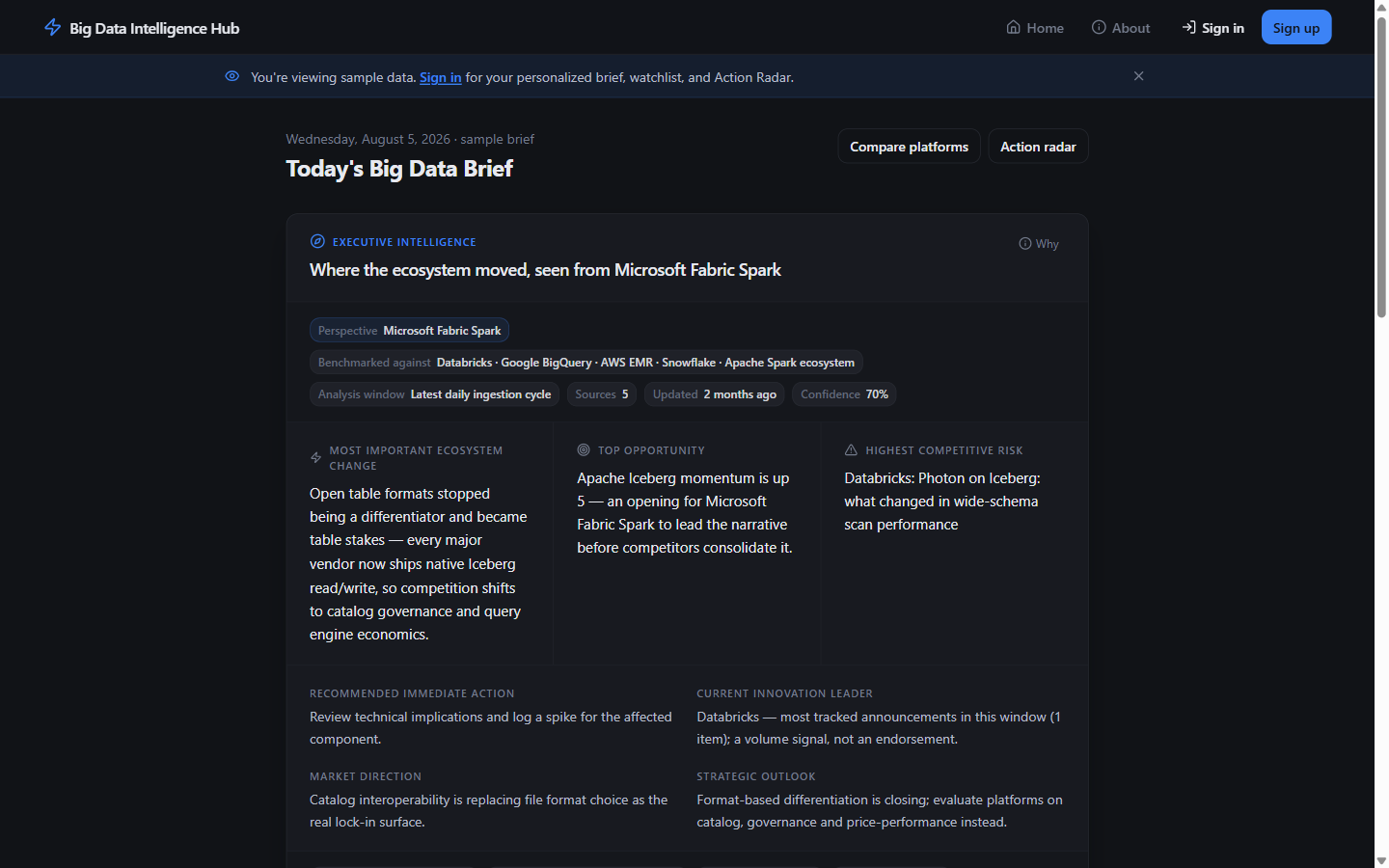
The Product Found Its Shape by Building
I didn't design version six on day one. Each version answered a question the previous one raised.
- v0Big data news
- v1Intelligence hub
- v2Live ecosystem
- v3Competitive intel
- v4Executive intel
- v5Action Radar
- v6Decision intelligence
- 2 AprLive pipeline and a daily brief, on day one
- 3 AprDaily email switched off
- 15 AprProduct spec written, after the prototype
- 21 AprFreshness rules and tiered sources
- 28 May"Ask the Hub" AI copilot
- AugRadar, decisions and outcomes
Prototype the workflow before you productionize the architecture.
One Prompt Did NOT Build This
People see the screenshot and assume it was magic. Here's what actually went into it. Notice how little of it is "prompting".
Problem selection
A pain I felt every week
User understanding
Who reads this, and when?
Information architecture
Brief, trends, radar, compare
Source selection
Tiered, trusted and fresh
Workflow decomposition
Ingest → filter → score → brief
Signal definition
What counts as "changed"?
Evidence handling
No evidence, no claim
Evaluation
Is this brief actually useful?
Iteration
500+ commits, 28 plans
Human judgment
It recommends; I decide
Reliability
Retries, run logs, fallbacks
Product design
Less reading, more deciding
The prompt was an accelerator. It was not the product strategy.
Prompting Is Not the Moat. Structured Thinking Is.
Same model, very different products, depending on how well I'd thought before I typed.
Weak
"Build me a big data news dashboard."
You get a generic news page. Pretty, and useless by Tuesday.
Better
"For a data-platform PM: pull posts from these sources daily, summarize them, group them by topic, and show a clean dashboard."
Defines the user, the sources, the output and a basic workflow.
Product-grade
"Score every signal: importance, confidence and the reasons why. Never merge impact and confidence. Drop release notes. If a run fails, fall back to the last good snapshot. Non-goals: billing, SSO."
Adds rules, evidence, edge cases, failure handling and non-goals.
The product-grade example is condensed from my real plan documents. The first two are illustrative.
From One Good Prompt to a Repeatable System
The real step change came when the product stopped depending on a single prompt and became a repeatable system.
- Prompt
- Output
- Tweak
- Re-prompt
- Prompt
- Context
- Workflow
- Evaluation
- Repeatability
- Product
In my product
Tiered sources, scoring rules, evidence requirements, quality checks and failure handling, written once and reused on every run.
Across a team
A shared rules folder every AI tool points to, plus reusable instructions that people and agents both use.
The future isn't prompt engineering at scale. It's context and workflow engineering at scale.
Sources: Zach Davis on How I AI, Jul 2025
From Information to Decision Intelligence
The first version told me what happened. The useful version helps me decide what to do, and remembers what I decided.
- 1InformationArticles, releases, posts
- 2IntelligenceFiltered, deduplicated, scored, explained
- 3DecisionAct now, watch or ignore, with an owner
- 4ActionTracked from open to done
- 5OutcomeDid it matter? Close the loop
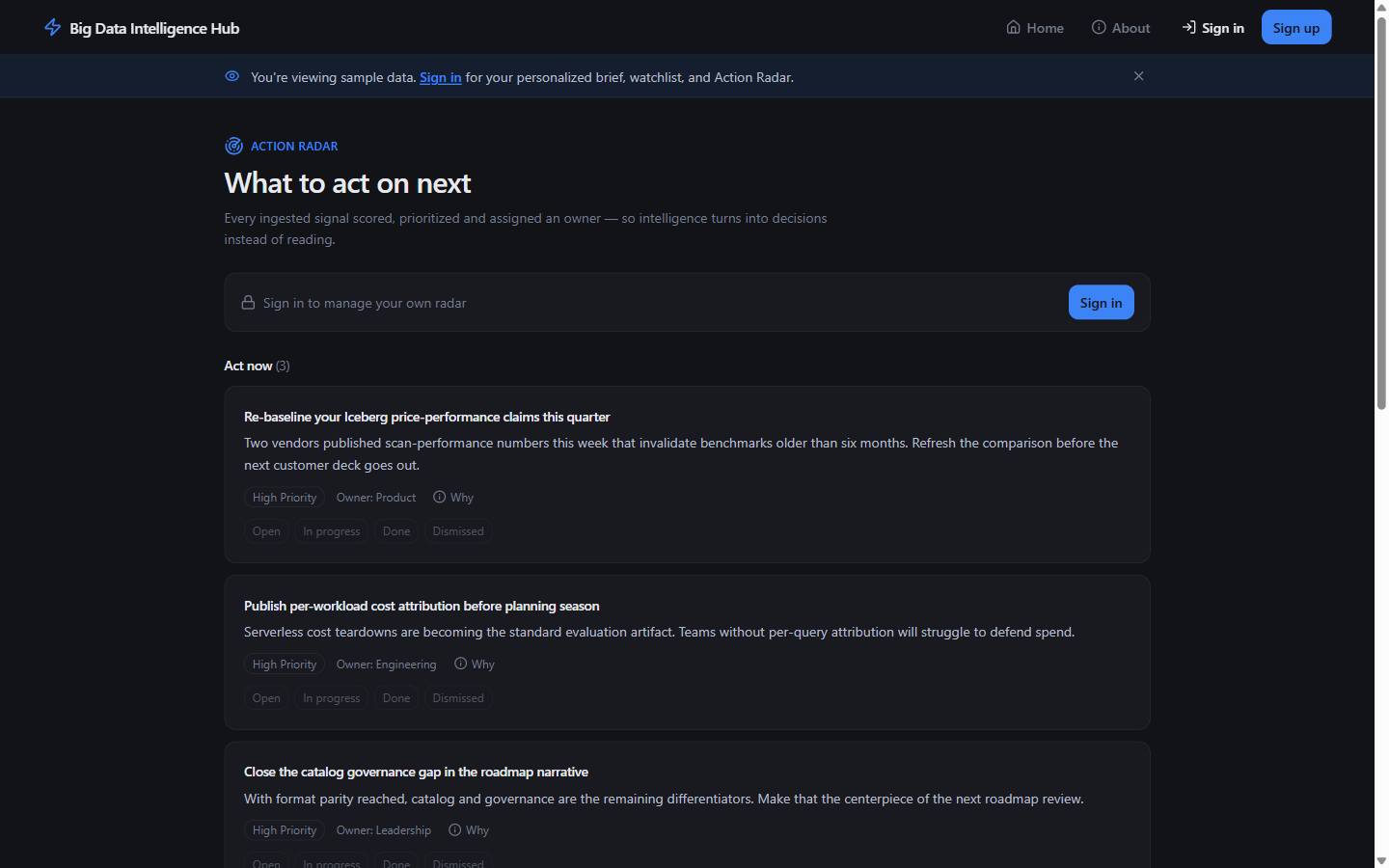
The system didn't make the decision. It helped me make, and remember, the decision.
What Makes an AI Product Good?
"The demo worked" is not an evaluation. I ended up checking five different layers, and each one can fail on its own.
| Layer | The question | How it shows up in my product |
|---|---|---|
| Model | Is the output grounded? | Recommendations carry their evidence; missing evidence stays neutral |
| Task | Did it do the job? | Duplicates removed, release notes dropped, stale items filtered |
| Product | Do people actually use it? | Visitors, sign-ups, questions asked: small numbers, honestly reported |
| Business | Is it worth it? | Not proven yet. It isn't monetized, and I say so |
| Safety & trust | Does it stay in bounds? | Read-only tools, confidence shown separately, graceful fallback |
Evaluation isn't one number. Each layer can pass while another quietly fails.
Responsible AI: Neither Fragile Nor Stalled
Responsible AI isn't a compliance afterthought. It's a product-quality requirement, and the PM's job is to know which failures matter.
Innovation without safeguards
Ships fast, then loses trust with one bad answer.
Safeguards without innovation
Nothing ships, so nothing is learned.
Innovation with safeguards
Ships, learns, and earns trust over time.
Every technology wave brings ways to hurt people, by accident or on purpose. Be conscious of that, and don't panic.
Benedict Evans, technology analyst · Paraphrased
The PM's job: decide which failures matter, design the safeguards into the product, and keep shipping.
From Information Mover to Product Builder
As AI moves more information for us, the relative value of moving it may decline. Decline, not disappear.
The information mover
- Relays updates between teams
- Turns meetings into documents
- Tracks status and chases owners
- Summarizes what others found
The product builder
- Frames the problem worth solving
- Turns intent into something testable
- Defines what good looks like
- Owns the outcome, not the handoff
Move decisions. Move outcomes. Move products forward.
Framing paraphrased from Nikhyl Singhal. A split market: 7,300+ open PM roles (most since 2022), but big-tech hiring is ~25% below 2019 and tilts to engineering.
Sources: Nikhyl Singhal on Lenny's Podcast · Lenny's Newsletter, PM job market, early 2026 · SignalFire State of Talent 2026
Five Capability Shifts, Not Five Job Titles
The labels running along the bottom of these slides are capabilities you can add, in any order, at any level. Most PMs will mix several.
- Information moverGathers, summarizes, routes
- AI-augmented PMSame job, done faster with AI
- BuilderTurns intent into working prototypes
- EvaluatorDefines and checks what good looks like
- Outcome ownerOwns results, risk and adoption
Not a ladder
You can be a strong evaluator before you ever build. Skip steps, mix them, come back.
Titles are still forming
AI PM, product builder, product engineer: names vary by company. The appendix maps the common ones.
One distinctive AI PM skill: translating frontier technical capability into understandable, trustworthy, useful product experiences.
Using AI vs. Redesigning Work Around It
Most teams are using AI. Far fewer have redesigned how they work around it. Here's a simple way to tell the difference.
| Level | What it looks like | An example |
|---|---|---|
| AI as a tool | Individual productivity | Where most of us started |
| AI as a workflow | A repeated task, redesigned around AI | My daily big data brief |
| AI as a team capability | Shared context, rules and reusable workflows | LaunchDarkly's shared agent rules |
| AI as a product capability | AI built into a product people use | My product's scored signals and MCP tools |
| AI as an operating model | The org changes how products get built | LinkedIn's full-stack builder pods |
Are you using AI, or are you redesigning how you build?
A thinking tool, not a benchmark. Teams in one company sit at different levels, and you don't need the top level to create real value.
Automate, Augment, or Leave It Human?
Pick one recurring problem from your own work, something real that annoys you every week. Fill in the canvas, then make the call.
User
Who has this problem?
Problem
What exactly goes wrong?
Frequency
Daily, weekly, quarterly?
Current workflow
How is it done today?
Pain
Time, errors or frustration?
Available data
What could AI actually see?
AI capability
Summarize, classify, draft or act?
Human decision
What must a person still own?
Success metric
How would you know it worked?
Biggest risk
What happens when it's wrong?
So: should you automate this, augment it, or leave it human?
Ask, Learn, Do: Your 30 / 90 / 365-Day Plan
Practical, not motivational. Each step leaves you with something you can show, not just something you read.
Ask and identify
Ask for one real AI problem on your team, and tell your manager you want to grow this capability.
Learn and build
Learn context, evals and data by building something real, then evaluating it honestly.
Do and own
Do the job before you have the title: own an AI-enabled product outcome.
Don't wait for the AI PM role to appear. Start demonstrating the behaviors of one.
What Will You Build That You Couldn't Build Before?
The future of product management isn't about competing with AI at producing output.
It's about getting better at choosing outcomes, framing problems, providing context, evaluating systems, and turning intent into responsible products.
So: are you using AI, or are you redesigning how you build?
Ask for one real AI problem on your team. Rebuild one workflow around it. Share what you learned, including what broke.
kunalparekh-portfolio.netlify.app·linkedin.com/in/kp27·bigdata-hub.lovable.app
Just Enough Technical Fluency
Not a technical course. Just the concepts that change product decisions.
| Concept | In plain language | Why a PM cares |
|---|---|---|
| LLM | A model that predicts likely text, code or answers | Powerful, but a probability engine, not a database |
| Context | Everything the model can "see" when it answers | Better context beats cleverer prompts |
| Grounding / RAG | Fetching real sources and answering from them | Your main defense against confident nonsense |
| Tools & MCP | Letting AI call your systems through a standard interface | Answers become actions, so permissions matter |
| Agents vs. workflows | The model picks the steps vs. you fix the steps | Start with workflows; earn your way to agents |
| Evals | Test sets that check whether AI output is good | Acceptance criteria for AI features |
| Hallucination | Fluent output that simply isn't true | Design for it: show sources, allow correction |
| Guardrails & human-in-the-loop | Limits, plus a person approving what matters | Where accountability actually lives |
| Cost, latency & drift | What it costs, how fast it is, how it changes | The unglamorous half of "production" |
What the Evidence Says, and How Sure We Are
| Claim | Source | Status |
|---|---|---|
| Scoped coding task finished 55.8% faster with an AI pair programmer | Peng et al., arXiv 2302.06590 (2023) | Verified |
| GPT-3.5-level inference cost fell 280× (Nov 2022 to Oct 2024) | Stanford AI Index 2025 | Verified |
| ~25% of YC W25 startups: ~95% AI-generated code | Jared Friedman (YC) via TechCrunch, Mar 2025 | Verified |
| Experienced OSS developers 19% slower with AI, but felt ~20% faster | METR randomized trial, Jul 2025 | Verified |
| Likely faster by early 2026, but uplift is getting hard to measure | METR update, Feb 2026 | Emerging |
| ~90% use AI; ~30% have little or no trust; AI acts as an amplifier | DORA State of AI-assisted Software Development 2025 | Verified |
| 84% use or plan to use AI; 46% distrust accuracy; 66% cite "almost right" | Stack Overflow Developer Survey 2025 | Verified |
| Length of tasks AI can finish doubled ~every 7 months for 6 years | METR, Mar 2025; Time Horizon 1.1, Jan 2026 | Verified |
| Retirement notice: 6+ months (OpenAI GA models), 60+ days (Anthropic) | OpenAI and Anthropic deprecation pages | Verified |
| 7,300+ open PM roles globally, the most since 2022 | TrueUp data via Lenny's Newsletter, early 2026 | Verified |
| Big-tech hiring ~25% below 2019; product lags engineering | SignalFire State of Talent Report 2026 | Verified |
| Fewer PMs per engineer at some firms; "no PMs" at some startups | Business Insider reporting, 2025 | Emerging |
Sources: Peng et al. 2023 · Stanford AI Index 2025 · TechCrunch on YC W25, 2025 · METR RCT, Jul 2025 · METR update, Feb 2026 · DORA 2025 · Stack Overflow Developer Survey 2025 · METR task-length study, Mar 2025 · METR Time Horizon 1.1, Jan 2026 · OpenAI deprecation policy · Anthropic model deprecations · Lenny's Newsletter, PM job market, early 2026 · SignalFire State of Talent 2026
Who Said What, and How This Deck Uses It
Named voices are perspectives, not proof. Here's how each one is used.
| Voice | What we use | Where | Status |
|---|---|---|---|
| Tomer Cohen | "…empower any builder who has a strong idea…" | LinkedIn Pulse, Jan 2025 | Quoted |
| Kevin Weil | Today's model is "the worst AI model you will ever use" | Lenny's Podcast, Apr 2025 | Quoted |
| Kevin Weil | Writing evals becomes a core PM skill | Lenny's Podcast; 2024 panel with Krieger | Prediction |
| Marily Nika | Prototype before the PRD, so experts react to it | Lenny's Newsletter; Aakash Gupta's podcast | Paraphrased |
| Zach Davis | One shared rules folder that every AI tool uses | How I AI, Jul 2025 | Paraphrased |
| Chandra Janakiraman | AI helps prepare strategy, even drafts mock ones | Lenny's Podcast, Jan 2025 | Paraphrased |
| Benedict Evans | Every tech wave brings harms; be conscious, don't panic | Lenny's Podcast, 2026 | Paraphrased |
| Andrew Ng | Deciding what to build becomes the bottleneck | The Batch | Paraphrased |
| Nikhyl Singhal | Information moving fades; builders thrive | Lenny's Podcast | Prediction |
| Kunal Parekh | Waves, maturity levels, Ask / Learn / Do | This deck | Interpretation |
Quoted: their exact words. Paraphrased: our wording of a documented point. Prediction: a view of the future, not a measurement. Roles as of the source date.
The Titles You'll Hear, and What They Emphasize
Titles are still forming, and they vary by company. Read them as emphasis, not a standard.
| Title | What it emphasizes | Closest capability shift |
|---|---|---|
| AI Product Manager | Shipping AI features: model behavior, data, evals and trust | Evaluator |
| AI Product Builder | Going from problem to working AI prototype, fast | Builder |
| Product Engineer | An engineer who owns product decisions end to end | Builder |
| Forward-Deployed Product Engineer | Building alongside customers, inside their workflows | Builder |
| Agent Experience PM | Designing products that AI agents can use well | Builder |
| AI Evaluation PM | Defining quality, test sets and launch readiness | Evaluator |
| Responsible AI Product Leader | Safeguards, governance and trust across products | Outcome owner |
| Product-oriented MTS | A technical staff role at an AI lab, with product scope | Builder |
| Founder-style PM | Owning the whole problem, from idea to adoption | Outcome owner |
Only the builder signal is clearly documented, via LinkedIn's Associate Product Builder program. The others are emerging labels, used differently by each company.
The AI-Native PM Capability Stack
Five capabilities. You don't need to be an expert in all five, but you should know where you stand on each.
| Capability | The question it answers | Learn next |
|---|---|---|
| Product judgment | Am I solving the right problem, with the right trade-offs? | Write down the decision you want to enable before you write a prompt |
| AI fluency | Do I know what AI can and can't do? | Learn context, grounding, tools and agents at a PM level |
| Building fluency | Can I turn intent into something testable? | Ship one working prototype with real data |
| Evaluation & trust | Can I tell whether it actually works? | Write 20 test cases before you demo anything |
| Outcome leadership | Can I turn experiments into real outcomes? | Tie one AI bet to a metric your leaders already care about |
Beginner and advanced behaviors for each capability are on the next slide.
What Good Looks Like, From Beginner to Advanced
| Capability | Beginner | Advanced | Common misconception |
|---|---|---|---|
| Product judgment | Starts from the tool or the solution | Starts from the decision the user needs to make | "AI will tell me what to build." |
| AI fluency | Uses chat for drafts and summaries | Knows when to use retrieval, tools, or no AI at all | "A better prompt fixes everything." |
| Building fluency | Clickable mockups | Working prototypes with real data and failure handling | "A demo is a product." |
| Evaluation & trust | "Looks good to me" | Test sets, error analysis, uncertainty shown to users | "Quality is one accuracy number." |
| Outcome leadership | Ships AI features | Moves a metric that matters, and owns the risk | "Adoption equals value." |
What I Can Show, and What I Don't Claim
The rules I used for the Big Data Intelligence Hub story, so you can hold me to them.
In the repo and live product
- 500+ commits, April to August 2026
- 28 written plan documents
- Ingest → filter → dedupe → score → summarize → trends
- Scores carry importance, confidence and reasons
- 4 read-only MCP tools for other AI agents
- Retries, run logs, last-good-snapshot fallback
From product analytics
- 134 unique visitors and 252 page views, 28 May to 28 Aug 2026
- 29 Jul to 28 Aug: 80 visitors, 7 registered, 3 active
- 8 copilot questions, 5 bookmarks
- 85% bounce rate: early, small, and honest
What I haven't measured
- Accuracy or precision benchmarks
- Time saved for users
- Revenue or business impact
- Adoption beyond a small early audience